Legislative Legacy

Political Career &
Legislative Leadership

A chronicle of decades of democratic service — from the constituency floor to the State Assembly, from cabinet governance to the constitutional chamber of the Speaker.

Constituency Leadership

MLA Journey — Navsari Constituency

The Navsari constituency in South Gujarat has been the foundation of Mangubhai Patel's democratic career. Elected as a Member of the Gujarat Legislative Assembly (MLA) from this constituency multiple times, he established a deep and enduring bond with the people — a bond forged through years of dedicated constituency service, responsive governance, and personal accessibility.

Navsari is a constituency of remarkable diversity. It encompasses urban areas within Navsari city — an ancient center of commerce and culture — as well as semi-rural and rural areas that are home to farming communities, tribal populations, and small-scale industries. The constituency's demographic complexity demanded a representative who could navigate multiple demands simultaneously: infrastructure development in urban areas, agricultural support in rural zones, and welfare programs for tribal communities.

Mangubhai Patel approached this challenge with a systematic, ground-level methodology. He established a regular constituency contact program that went far beyond the typical political practice of periodic visits. He maintained a network of local coordinators across villages and urban wards who served as the eyes and ears of the constituency, ensuring that emerging issues were identified and addressed before they escalated into crises.

His focus areas in Navsari included improving rural road connectivity — linking remote villages to district and state highways, thereby facilitating access to markets, healthcare facilities, and educational institutions. He advocated for the expansion of irrigation infrastructure, recognizing that water management was critical for the agricultural economy of South Gujarat. He also championed the cause of tribal education, pushing for improved school infrastructure and teacher availability in tribal areas.

Within the Gujarat Legislative Assembly, Mangubhai was recognized as a diligent legislator. He regularly participated in debates, raised questions pertaining to his constituency and broader state issues, and served effectively on legislative committees. His interventions in the Assembly were characterized by a practical, evidence-based approach — he rarely engaged in political theatrics, preferring instead to focus on concrete policy discussions and constructive criticism.

This combination of constituency dedication and legislative diligence earned him a reputation as one of the most reliable and effective MLAs in the Gujarat Assembly — a reputation that would eventually propel him to higher responsibilities within the state government.
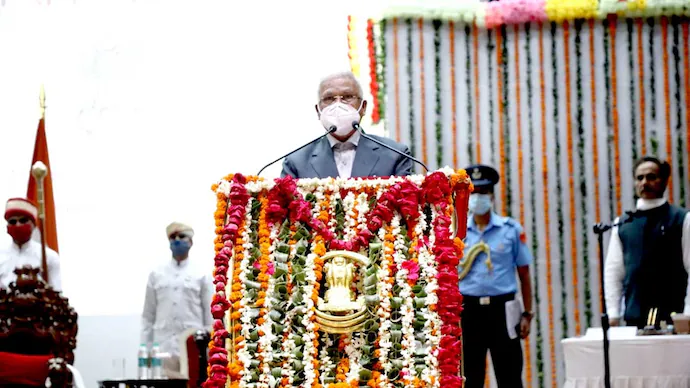
Mangubhai Patel addressing constituency

Navsari Constituency

A constituency of remarkable diversity — encompassing urban, rural, and tribal communities in South Gujarat.
5+
Terms Elected
30+
Years of Service
Mangubhai Patel in ministerial role
Executive Leadership

Cabinet Minister — Government of Gujarat

Mangubhai Patel's appointment as a Cabinet Minister in the Government of Gujarat was a significant milestone that marked his transition from a constituency-focused legislator to a state-level policy maker and administrator. This appointment was a recognition of his proven track record as an MLA, his organizational contributions to the BJP, and his administrative capabilities that had been demonstrated through years of public service.

As a Cabinet Minister, Patel was entrusted with portfolios that directly impacted the lives of millions of Gujaratis, particularly those in rural and semi-urban areas. His ministerial tenure was characterized by a hands-on approach to governance — he was known for personally visiting project sites, reviewing implementation progress, and holding field-level reviews that went beyond the routine bureaucratic assessments.

One of the distinguishing features of his ministerial tenure was the emphasis on last-mile delivery. Having spent years at the grassroots level, Patel was acutely aware of the gap between policy announcements and actual implementation. He established monitoring mechanisms that focused not just on financial allocation and expenditure — the conventional metrics of government performance — but on actual outcomes: the number of families benefited, the kilometers of roads actually constructed and usable, the number of students who received quality education.

His ministerial contributions extended beyond his specific portfolios. As a senior cabinet member, he participated in collective decision-making on major state policies and contributed to the overall governance agenda of Gujarat. His inputs in cabinet meetings were valued for their practicality and their rootedness in ground-level realities — a perspective that is sometimes absent in high-level policy discussions.

The administrative experience gained during his ministerial tenure — managing large bureaucracies, navigating inter-departmental coordination, balancing multiple priorities, and maintaining accountability — would prove invaluable when he was later appointed as the Governor of Madhya Pradesh, a state with its own unique administrative challenges and developmental needs.

Parliamentary Authority

Officiating Speaker — Gujarat Legislative Assembly

In 2014, Mangubhai Patel was called upon to serve as the Officiating Speaker of the Gujarat Legislative Assembly — a role that demanded the highest standards of parliamentary propriety, impartiality, and procedural expertise.

The Speaker's office occupies a position of unique authority in India's parliamentary system. The Speaker presides over the legislative assembly, maintains order during debates, interprets the rules of procedure, and ensures that legislative business is conducted in accordance with established parliamentary conventions. It is an office that requires not only a deep knowledge of parliamentary procedure but also the temperament to remain impartial between contesting political positions.

For Mangubhai Patel, the role of Officiating Speaker represented the culmination of his legislative career in Gujarat. Having served in the Assembly for multiple terms, he had acquired an intimate understanding of its procedures, traditions, and culture. He understood the delicate balance that the Speaker must maintain — between allowing free expression and maintaining orderly conduct, between protecting the rights of the minority and facilitating the business of the majority.

His tenure as Officiating Speaker was marked by a commitment to upholding the dignity of the House. He ensured that debates were conducted with decorum, that members were given fair opportunity to present their views, and that the rules of procedure were applied consistently and impartially. This parliamentary experience added a crucial dimension to his political résumé — demonstrating that he was not merely a party politician but a parliamentary leader who could rise above partisan considerations when institutional integrity demanded it.

🏛️

Presiding Over the Assembly

Maintaining order, interpreting rules, and ensuring the smooth conduct of legislative business in one of India's most active state legislatures.

⚖️

Impartial Adjudication

Setting aside partisan considerations to protect the rights of all members, ensuring fair debate, and upholding the democratic character of the legislative process.

📜

Procedural Expertise

Applying decades of legislative experience to interpret parliamentary rules, resolve procedural disputes, and maintain the institutional integrity of the Gujarat Assembly.

Reflection

Legislative Leadership Insights

Mangubhai Patel's legislative career offers several insights into effective democratic representation in India's multi-layered political system. His journey from a grassroots party worker to a constitutional authority demonstrates that sustained, dedicated public service — rather than transient political celebrity — remains the most durable path to leadership in Indian democracy.

First, his career underscores the importance of constituency-based politics. In an era where electoral campaigns are increasingly centralized and driven by national narratives, Patel's success in Navsari was built on intimate knowledge of local issues, personal relationships with constituents, and tangible delivery of developmental outcomes. This model of representation — where the elected representative is accessible, accountable, and responsive — remains the bedrock of India's democratic system.

Second, his progression through different institutional roles — from legislator to minister to Speaker to Governor — illustrates the value of diverse institutional experience. Each role taught different lessons: the legislature taught debate and deliberation; the ministry taught administration and implementation; the Speaker's office taught impartiality and procedural integrity; and the Governor's office has taught constitutional propriety and the art of governance without executive power.

Third, his career demonstrates the BJP's organizational approach to leadership development. Unlike political systems where leaders emerge primarily through dynastic succession or individual charisma, the BJP's cadre-based system has provided a structured pathway for leaders like Mangubhai Patel to rise through merit, organizational contribution, and demonstrated competence.

These insights, drawn from a career spanning over five decades, offer valuable lessons for the next generation of political leaders — lessons in patience, institutional respect, grassroots engagement, and the enduring importance of serving the people with humility and integrity.